First-Event Readiness Checklist
A complete owner-to-operator checklist for account setup, event configuration, rehearsal, live operation, and post-event delivery.
Written By 4ALL.LIVE
Last updated About 2 months ago
Provide a single gated checklist that prevents common first-event failures and creates a clear go/no-go decision.
Best for: Organization owners, administrators, producers, operators, accessibility leads, broadcast engineers, and backups.
Before you start
Review entitlements, wallet/usage, billable roles, target-language limits, ASL, Remote Control, desktop licenses, and export availability before committing the workflow.
A named event owner and live producer.
A written scope covering audience, languages, outputs, accessibility services, schedule, and deliverables.
Primary and backup audio, operator, network, and display plans.
Access to the actual venue or representative end-to-end test path.
Checklist
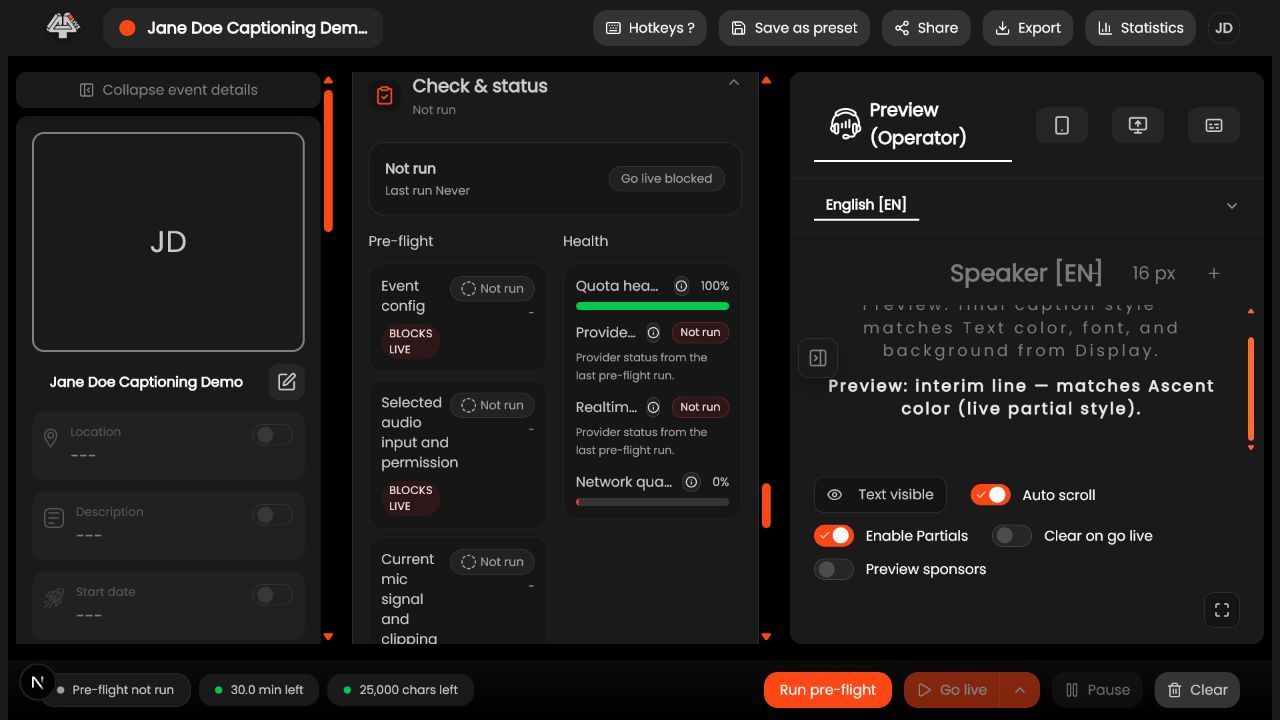
Seven or more days before: establish ownership. Confirm organization, billing owner, event producer, caption operator, audio owner, network owner, display/stream owner, ASL roles, support contact, and final stop authority.
Seven or more days before: verify account and entitlements. Accept invitations; test role/team access; review plan features, limits, wallet, auto top-up, payment method, add-ons, BYOK credentials, and desktop license assignments.
Three to seven days before: create and describe the event. Set name, team, image, location, description, dates, slug, speakers/panels, privacy URL, lobby behavior, visibility, and attendee instructions.
Three to seven days before: configure production. Complete Input & Routing, source language/provider, translations, glossary, caption tuning, Program Display, ASL, outputs/destinations, sharing, Remote Control, and any XPression Bridge or Encoder configuration.
One to three days before: rehearse end to end. Use the real audio path and representative speech. Inspect source captions, all target languages, venue screens, mobile viewer, overlays, XPression program, embedded CEA decoder, ASL viewer, and stream receiver as applicable.
One day before: freeze and document. Save a setup preset when useful, record approved settings, links, machine names, ports, licenses, contact tree, fallback steps, and accepted advisories. Schedule automatic updates outside the production window.
Sixty minutes before: technical line check. Power and cable devices, confirm clocks, disable notifications/sleep, verify browser/device permissions, open destinations, start desktop bridges/encoders, and test downstream returns.
Thirty minutes before: run preflight. Resolve blocking items; review provider, network, audio, languages, entitlements, outputs, and operator ownership. Rerun after any material change.
Ten minutes before: final go/no-go. Confirm program return, audience link/QR, captions, translations, ASL, logs, viewer support, backups, recording policy, and communication channel. Announce the current risk state.
At cue: go live. Start in the approved order, verify fresh captions and final outputs, announce on-air confirmation, and begin monitoring.
During: monitor and record decisions. Watch audio, providers, captions, translations, outputs, audience impact, usage, and operator presence. Change one layer at a time and log incidents.
At end: stop deliberately. Stop outputs and the live session in the approved order, verify offline state and cleared/held graphics, preserve logs, release licenses/devices, and communicate completion.
After: deliver and improve. Generate approved transcripts/exports, verify privacy and speaker data, review analytics and usage, reconcile billing, document incidents, update presets/runbooks, and revoke temporary access.
Ready means: The team reaches a documented go/no-go decision, operates the event with verified end-to-end monitoring, and completes delivery and access cleanup.
Final readiness check
Every line has an owner and completion state.
The final downstream output was tested with known content.
Fallbacks were rehearsed, not merely discussed.
The backup operator can access the event and instructions.
Post-event deliverables and retention are approved.
Troubleshooting
Preflight passes but the final output is wrong
Preflight verifies platform readiness, not every external receiver or screen. Add downstream acceptance tests to the checklist.
Last-minute feature is unavailable
Check plan/entitlement, member permission, event toggle, wallet/usage, provider credentials, add-on, and desktop license before changing the production promise.
A rehearsal used different hardware or network
Repeat the critical test on the production path; device IDs, drivers, ports, scaling, and firewall rules can differ.
Security and operational notes
Do not treat accepted advisory checks as invisible; name the risk, owner, mitigation, and rollback.
Never send private-control, credential, or interpreter-stage information in public attendee instructions.
For regulated or life-safety use, supplement 4All with the organization’s required certified and redundant services.
If the event uses LL-TTS or attendee headsets
- Confirm LL-TTS eligibility, wallet funding, separate input/output audio-token caps, and each demanded target language.
- Keep the producer browser active and verify independent, isolated room or program feeds.
- Authorize Signal for the correct workspace and assign a dedicated physical audio-interface output per required handoff.
- Name responsibility for transmitters, receivers, headsets, cabling, RF coordination, and venue approval.
- Rehearse the complete listener path and document a practical fallback for every required language and room.
Related guides
🪄 Setup Wizard
🩺 Preflight and Readiness
🔴 Live Controls
📦 Exports, Deliverables, and Statistics